Do I need Fast Frames?

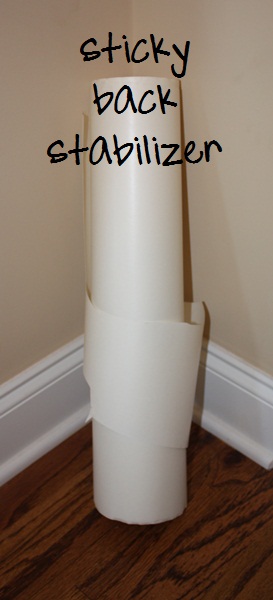
If you have a multi needle machine, chances are you have heard about FAST FRAMES! You may have them and use them for everything, or you may not have them and are not quite sure what they are used for. If this is you, this is your post! I have them, but I have to admit I don’t use them very often. But, they are nice to have for those things you “can’t hoop” or are hard to hoop (i.e., big bags, tiny bibs, etc.) Some people use them for EVERYTHING, including shirts. I am a “hooper“, so I hoop everything that I can and pull out the fast frames when I need them for those things that I can’t hoop, or that are hard to hoop. If you have fast frames, then you must have Sticky Back Stabilizer. I got mine from Sewingmachine.com and it’s great! There are sticky stabilizers that are just that ~ sticky (too sticky). I find this sticky stabilizer easy to use and not too sticky, meaning it will easily pull off the back of whatever it is you’re working with, and it will pull off of the fast frames with ease. I’ve had this roll forever!
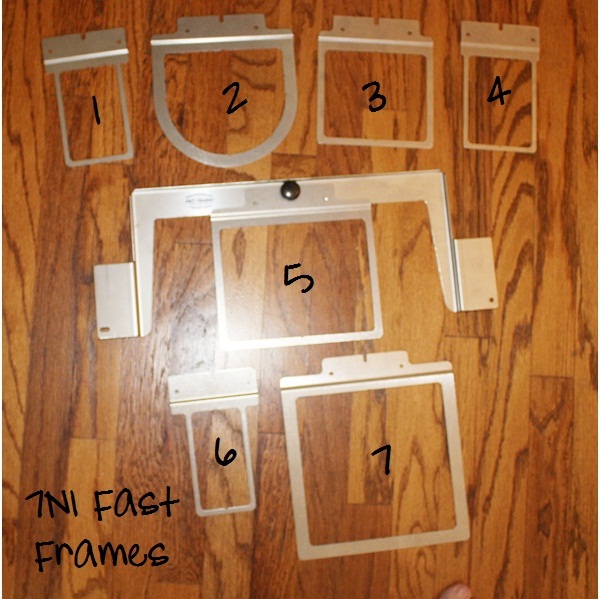
Here are my fast frames, called the 7N1 Fast Frames Hooping System. Again, I got mine at Sewingmachine.com. As you can see the set comes in a variety of sizes and there are larger sizes available to purchase separate from this 7N1 system.
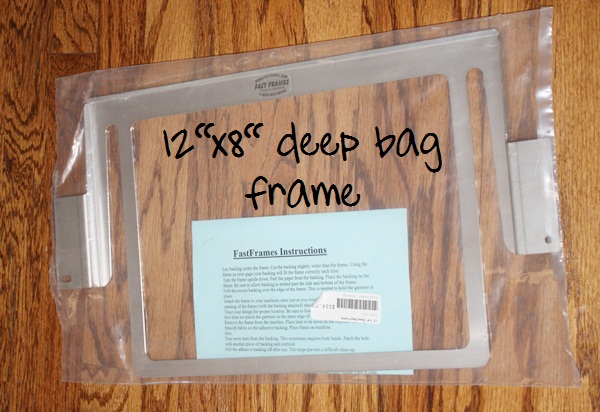
I also have this deep bag frame for those large items you might need to monogram or applique. As you can see the frames come with written instructions!
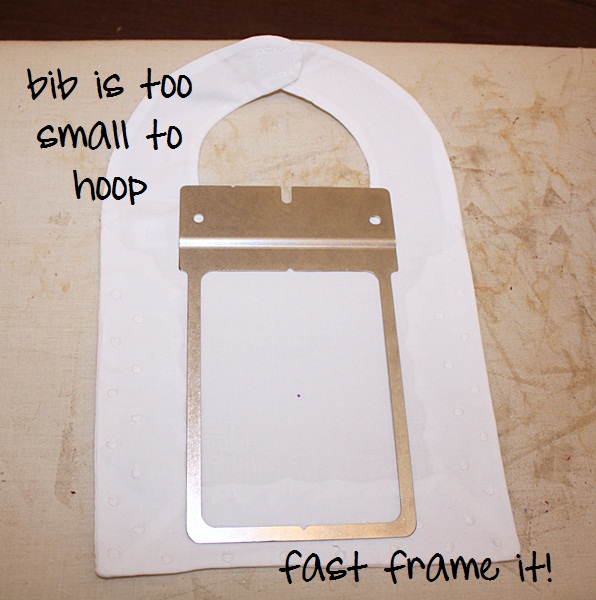
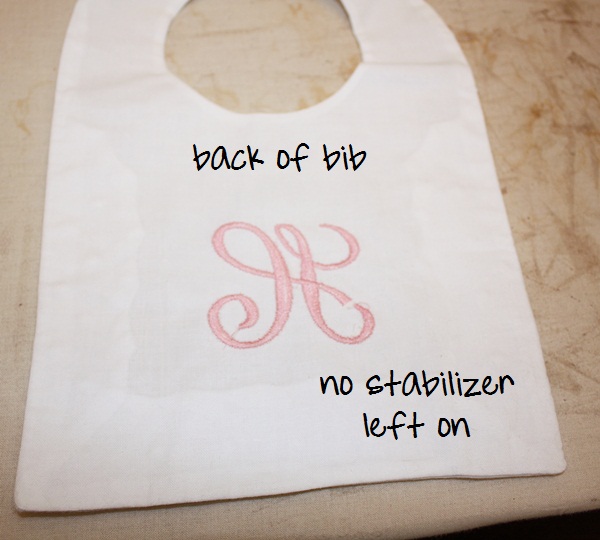
So today I am monogramming a simple “H” on this dainty little white linen bib. I COULD hoop this bib with my 4×4 hoop (and I would use an iron on tearaway stabilizer had I hooped it), but I’d hate to mess it up and this was the perfect illustration for my fast frames! I picked out the frame that would best fit the bib and the size of the “H”.
I cut a piece of my sticky back stabilizer a little larger than my frame.
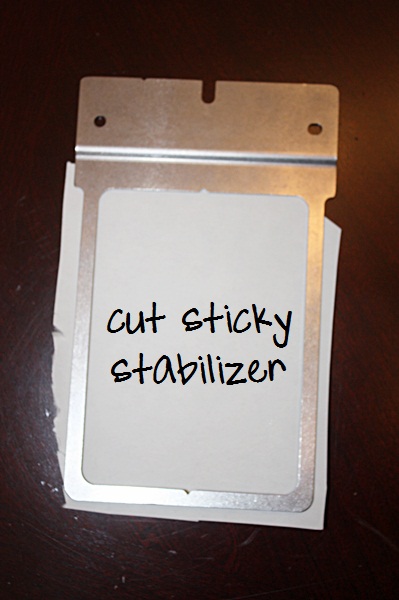
I peel away the paper leaving the sticky back to stick to my frame.
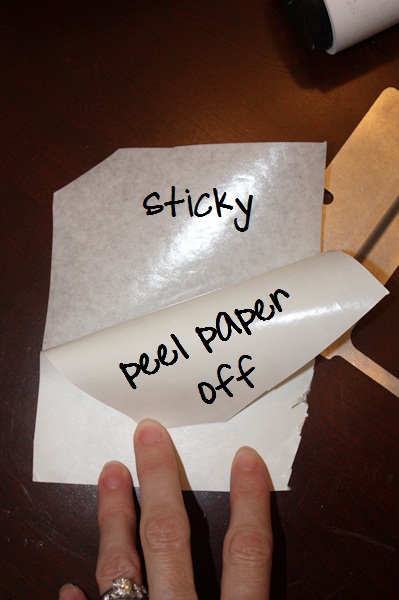
The frames come with instructions and you may be able to see that there is a bend in the frame which will be sloped down. I place the sticky back under the frame sticky side up and stick the frame to it.
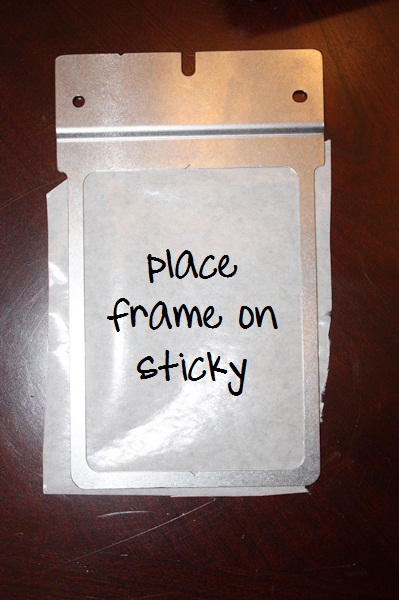
I wrap the edges of the sticky around the frame for added security. As you can see it’s not perfect and doesn’t wrap around on all sides. This is fine! The bib is not going anywhere.
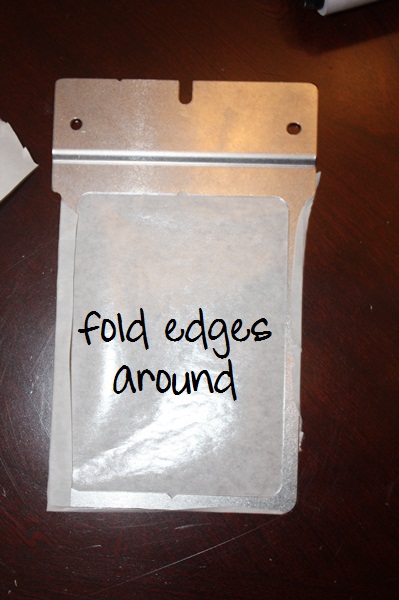
I place the bib on the sticky back on the frame and it’s “stuck” in place. I eyeball it for centered-ness (I think I made up a new word?).
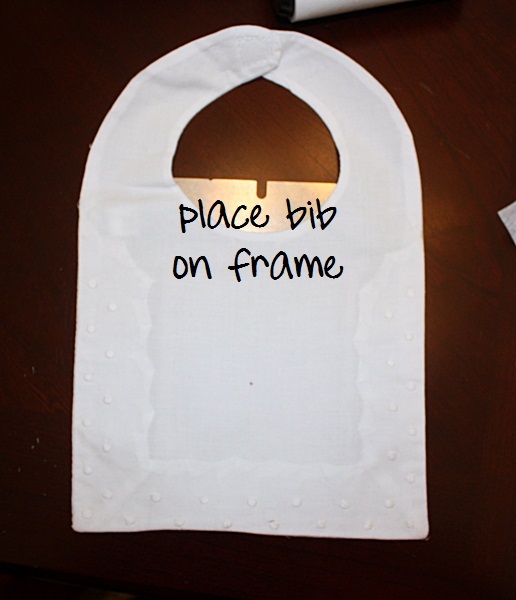
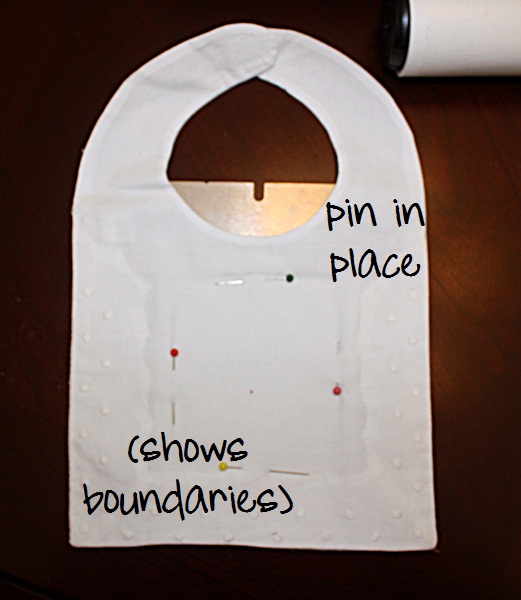
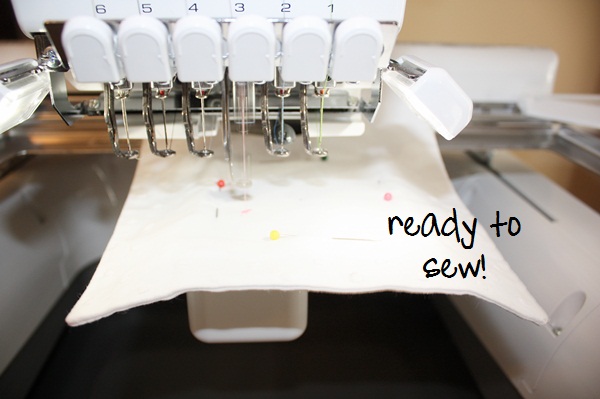
I also pin the bib to the sticky stabilizer. This serves 2 purposes. 1) the bib is definitely not moving or going anywhere and 2) I now know where my borders are. Your machine does not recognize fast frames, so it is up to you to make sure you know where your borders are and that the needle is not going to knick or hit one of the sides of the frame (VERY IMPORTANT!!). I pinned just inside the frame so I know my needle can’t go further than my pins!
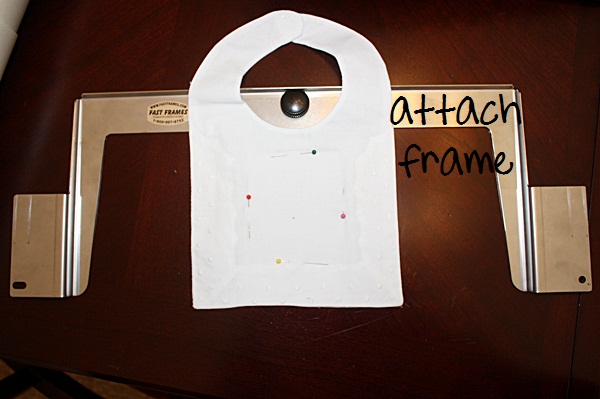
I now attach my frame to my big frame. It’s ready to go on my machine.
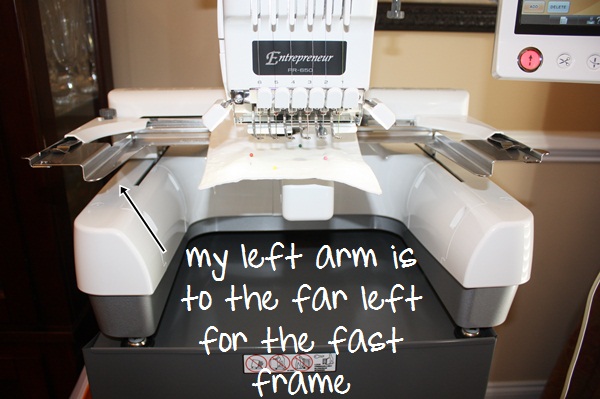
On my machine (Brother PR650), the left arm is adjustable and it will go almost all the way to the left for my fast frames and I tighten the screws so that the frame is secure and not going to move. My machine now thinks I have my largest hoop on, so it’s up to me to make sure the needle is not going to hit any part of the fast frame. I know that sounds confusing but you will get used to it!
I now line up my lead needle with my center mark on the bib. You can pull the needle shaft down to make sure it’s lined up if you don’t trust your eyeballs!
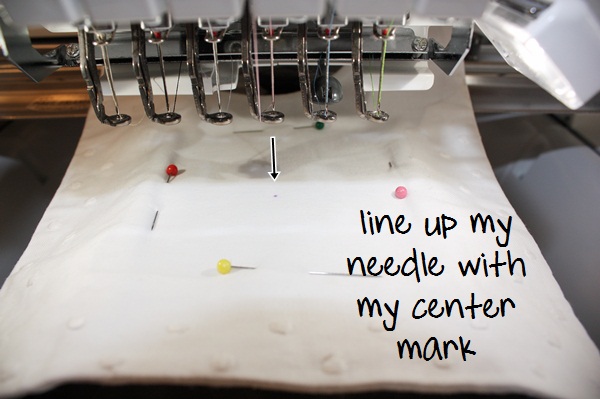
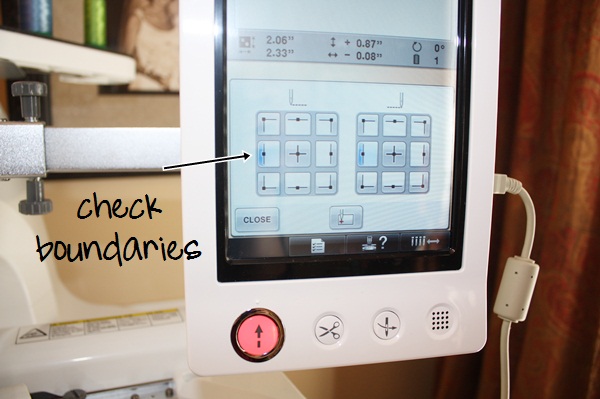
Here is where I check my borders. On my machine you can check your parameters and it will move the needle to any position you tell it to. So I go left, right, top, bottom and make sure my needle is within my pin borders and is not going to hit any part of the frame! If you are working on a big fast frame, then this is not as crucial if you have plenty of room. I’m working on a pretty small frame so I need to be sure my H is going to fit!
Ready, set, go!
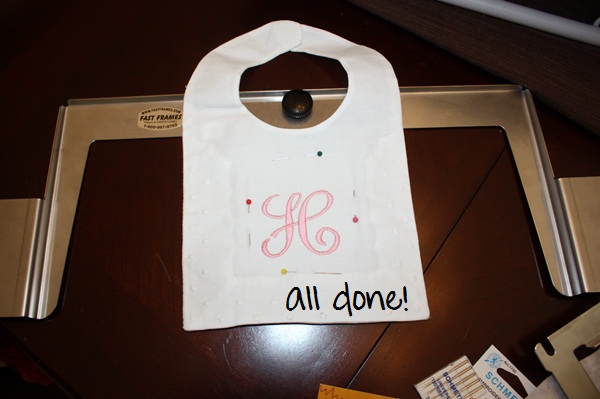
I’m now all done and as you can see, the H fit nicely within my pins.
I pull the bib off the sticky, then peel the sticky off my fast frame and pull any little pieces off the back of my bib.
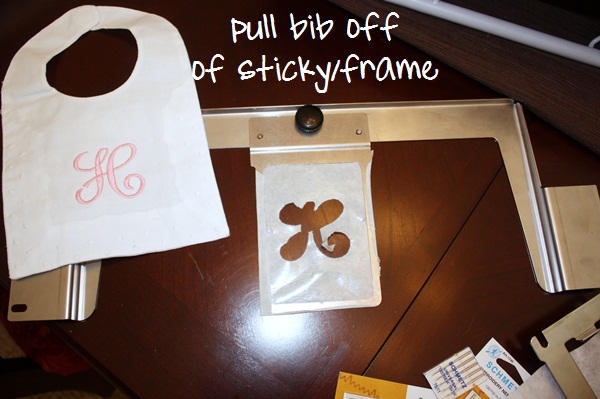
As you can see there is no stabilizer left on the bib. This is the case with all STICKY and TEARAWAY stabilizers. A cutaway stabilizer would be left on and you’d trim around it, but that’s another post!
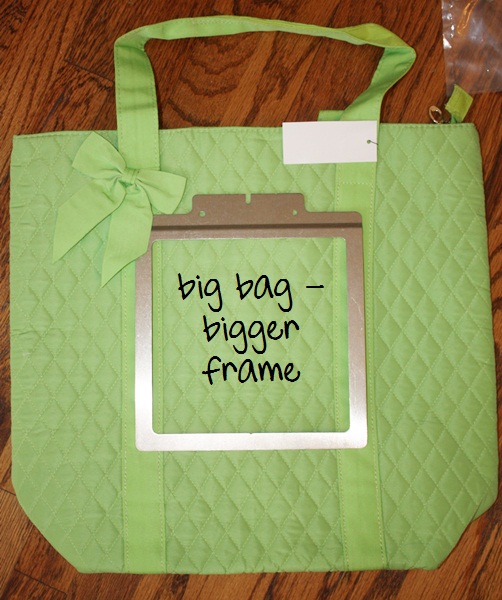
Here is an example of when I would use a larger fast frame ~ this lime green duffle bag (also from Sewingmachine.com). It would be very hard to hoop this bag because, a) it’s big and bulky and b) the thick ribbon would make it almost impossible to hoop and stay hooped! I would put sticky back stabilizer on this frame, stick the bag to it and pin it in place and monogram away!
For those of you who use fast frames for everything, then this is elementary to you! But, there are those of you who are contemplating a multi needle machine and wondering “do I need fast frames?”. I hope this helps!
Happy Valentine’s Day

Happy CANDY Day! My kids came home with BAGS of candy! It’s going to be fun when they want to eat it for every meal and their mean ole Mama says NO!!! We are foregoing the Valentine dinner out tonight since one year Jeff & I ended up at Moe’s. Instead we’re going to go to dinner and to a movie tomorrow night sans kids. Steak on the grill tonight!

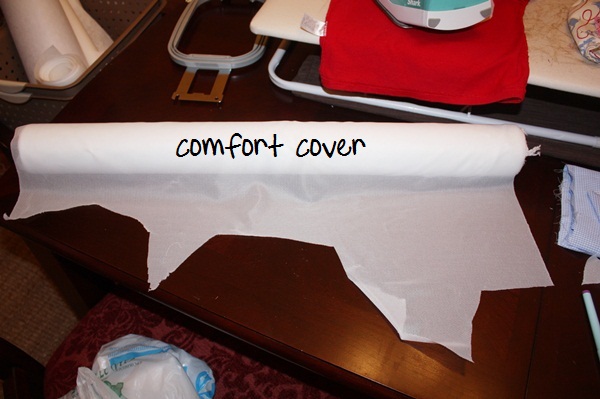
OK…. COMFORT COVER! I use it on the back of the applique on the inside of the shirt. It’s not a necessity but I’ve always used it. You may have seen it on the inside of your Carter’s brand clothing (if there is an applique on it) or your (Belk) J. Khaki dresses. The question is ~ does it come off? The answer is SOMETIMES! Sometimes it doesn’t. I personally think it’s a nice touch for your customers and for the cost of each little piece per shirt, it is worth the risk. I’m using a regular old Shark iron I bought at Target. I iron it on all of my customer’s shirts and if eventually it starts to come loose and peel away, then it’s not a big deal! It doesn’t ruin the shirt – it’s just a protective covering for the applique mainly used to prevent the threads from touching the skin. This is important to some kids ~ my kids don’t care! A raw monogram or applique doesn’t bother them at all. I have had it come off of my Carter’s clothing before, so I think it’s just the nature of the product and your washing machine and dryer. Regardless, I think it’s a nice touch and if you’re interested in it, then here is your post! Like I said, it doesn’t always come off, but I’ve had several people ask about it coming off so I can’t say that it absolutely doesn’t! I bet a heat press would help!?

As you can see I have a huge roll of it which I’ve been using for like a YEAR! I got it from Sewingmachine.com and I’m not sure if they typically sell this size roll? It may come in a much smaller roll. Another brand of this type product is Floriani and they call it Dreamweave. Sulky makes their version too. I believe it comes in black too. As you can see I just cut pieces from the large roll.

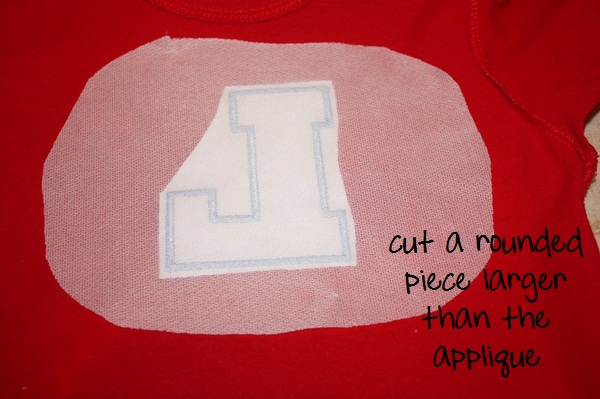
Do you love my notes on all of my pictures? I do! I cut a piece larger than the applique and I always round the edges.

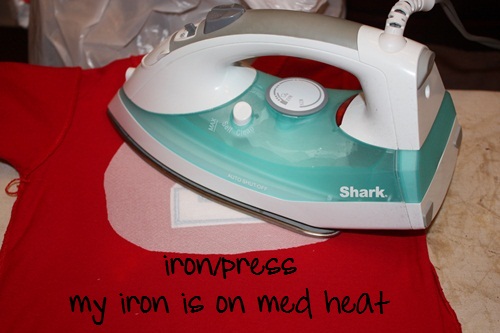
I simply iron over the comfort cover, sometimes pressing down on it for 10-12 seconds or so. That’s it! As you can see my iron is on medium heat and no steam I believe. Just follow the directions!

I hope that helps! Some people saw it on my HNBL post and asked about it, so here you go!

Layering Fabrics in an Applique…

I took these pictures the other day as I sampled the Applique Cafe (not listed yet) zig zag VW car. I did a post once before on layering fabrics in an applique, but this is a better post on what to do when your applique has *layers*. It’s not NECESSARY for you to do yours this way, but it’s the way I do it so I wanted to share!

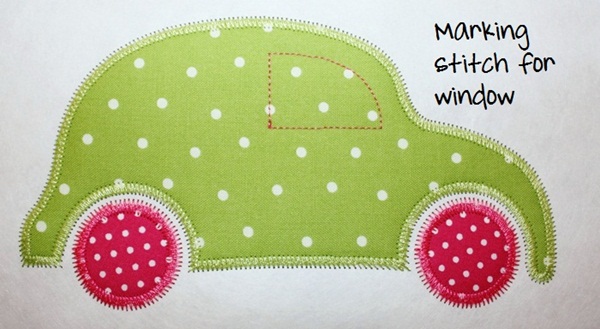
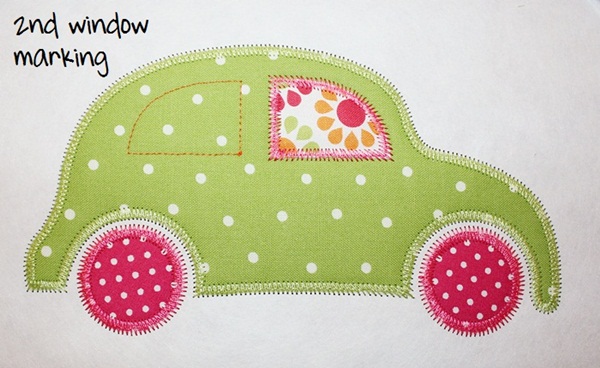
First… as you can see I’ve already sewn the marking, tackdown & zig zag stitches for the body of the car (step 1, 2 and 3) and for the tires (step 4, 5 and 6). This would be step 7 in my applique process for this design. It sewed the marking stitch for the right window.

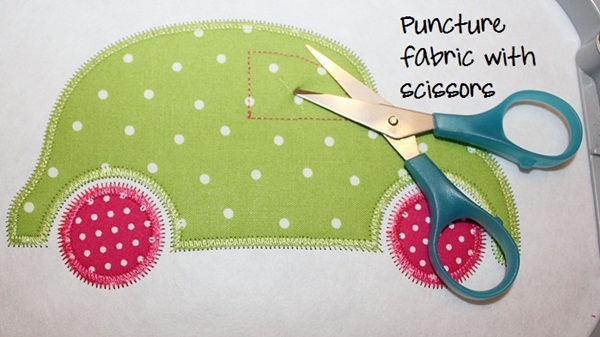
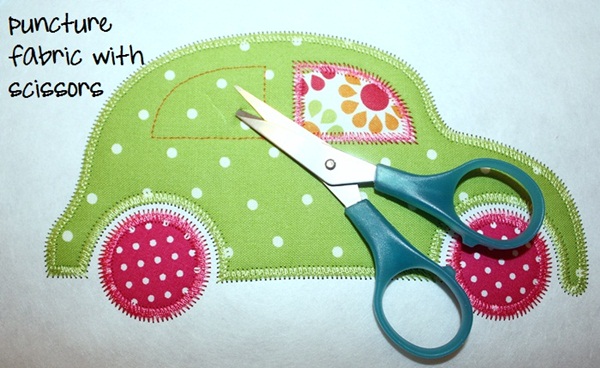
As you can see below, I’m using some blue handled embroidery scissors that came with my machine. They are dull as can be, but I still use them for steps such as this! With the scissors at an angle I just puncture through the fabric, then trim inside that marking stitch. I usually use my 4″ curved Gingher embroidery scissors for trimming.

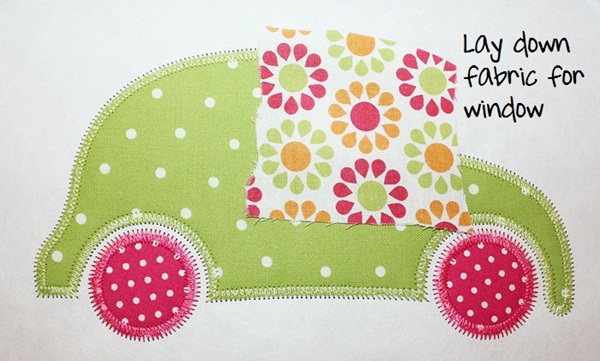
I’m now ready to lay my window fabric down (which has Heat N Bond Lite on it) for the right window tackdown stitch (step 8). The whole reason for this post… you COULD layer the floral fabric on top of the green polka dot car fabric, which is totally fine if that’s what you want to do. However, if your bottom fabric is darker than your top fabric, and you think the bottom fabric might show through, then follow these steps so that now the only fabric under your floral window is white shirt! Are you following me?

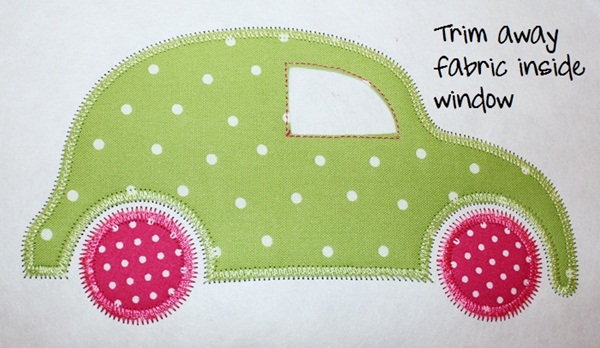
Skip ahead… I did not take pictures of every single step. Sorry! It did the tackdown for window 1 (step 8), I trimmed around the tackdown and it sewed the zig zag stitching around the right window (step 9). Below, marking stitch for left window is sewn (step 10 for this design).

Again, I punctured through the window fabric with my blue scissors (at an angle) and trimmed inside the marking stitch, leaving only the white garment underneath. In this case I used 2 layers of stabilizer (sample) but it would be the shirt in most cases. (I do a lot of my website samples on stabilizer) NOTE: You do have to be careful as to not poke a hole in the shirt. That’s why I go in at an angle!

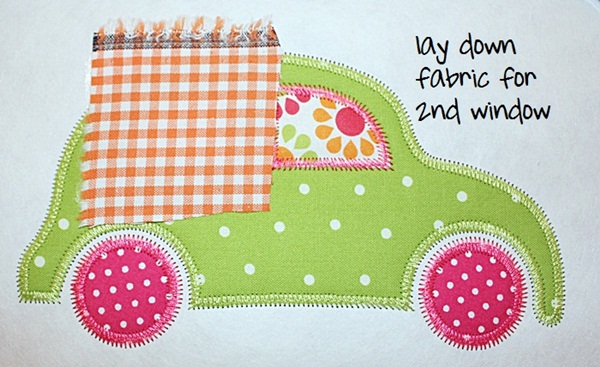
As you can see below I put down my orange gingham fabric for the left window. It’s now ready for the tackdown stitch for this window (step 11).

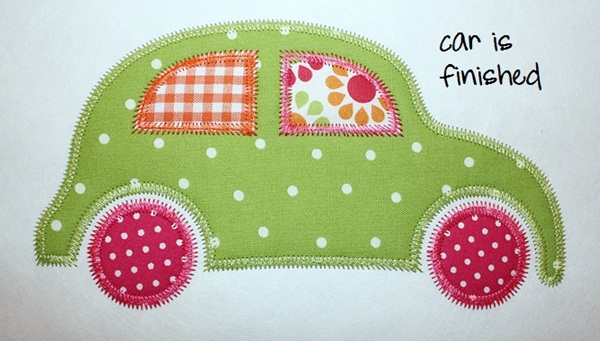
Again, I didn’t photo every step. I trimmed around the window and it finished up with the zig zag stitching around the left window (step 12). The car is now complete!!

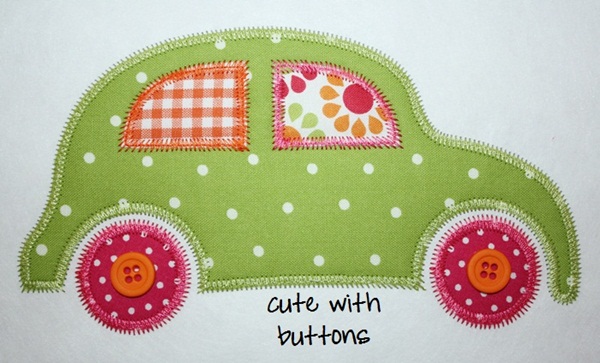
My kids had so much fun with my bag-o-buttons! Here I laid down 2 orange buttons in the tires and it adds a ton to the design! I would have sewn the buttons on by hand had this been an actual sample shirt.

So there you go! Here is one way to do an applique where fabrics are to be layered on top of one another. Like I said, it’s not necessary but this is what I do. It works especially well when your bottom fabric is much darker and liable to show through the top fabric.

YEAH! My first *REAL* applique post! I’m still getting the hang of WordPress so bare with me! I hope this post was helpful!